
 简体中文
简体中文 English
 عربى
عربى
PE ACP Production Line: Process, Specs & Quality Guide
A PE ACP (Polyethylene Aluminum Composite Panel) production line is a continuous extrusion and lamination system that bonds two aluminum coil skins to a polyethylene core, producing flat composite panels used in building facades, signage, interior decoration, and industrial cladding. If you are evaluating, purchasing, or operating a PE ACP production line, the most critical decisions involve coextrusion die configuration, lamination roller pressure uniformity, and core compound formulation — these three factors determine panel flatness, peel strength, and surface finish quality above all others.
This guide breaks down how the production line is structured, what specifications matter when selecting equipment, and what process parameters control final product quality.
Content
- 1 What PE ACP Is and Why the Production Process Matters
- 2 Core Stages of a PE ACP Production Line
- 3 Key Equipment Specifications to Evaluate
- 4 PE Core Formulation and Its Effect on Panel Properties
- 5 Critical Quality Control Points Along the Line
- 6 Common Production Defects and Their Root Causes
- 7 Line Configuration Options and Customization
- 8 Factors That Affect the Total Cost of Ownership
- 9 Selecting the Right PE ACP Production Line for Your Operation
What PE ACP Is and Why the Production Process Matters
Aluminum Composite Panel with a polyethylene core consists of two pre-painted or mill-finish aluminum sheets (typically 0.3–0.5 mm thick) permanently bonded to a low-density polyethylene core that makes up the majority of the panel's total thickness — standard finished panels range from 3 mm to 6 mm, with 4 mm being the most common commercial specification.
The PE core gives the panel its lightweight advantage. A standard 4 mm PE ACP panel weighs approximately 5.5–6.0 kg/m², compared to 8–10 kg/m² for aluminum sheet of equivalent rigidity. This weight reduction translates directly to lower structural load requirements and easier installation.
The production line determines the bond quality between the aluminum skins and the PE core. A poorly tuned line produces panels with delamination, surface waviness, or inconsistent core thickness — defects that only become apparent after installation, at significant cost. Peel strength of at least 120 N/25mm is the industry threshold for a structurally acceptable PE ACP panel under standards such as ASTM D1876 and EN 1396.
Core Stages of a PE ACP Production Line
A complete PE ACP production line operates as an integrated, continuous process. Each stage feeds directly into the next with no batch interruption. Understanding each stage is essential for diagnosing quality issues and specifying equipment correctly.
Aluminum Coil Feeding and Decoiling
Two aluminum coil reels — one for the top skin, one for the bottom — feed into the line simultaneously. Decoilers with hydraulic tensioning maintain consistent coil tension to prevent coil slack and surface scratching. Most production lines use double-headed decoilers that allow a fresh coil to be loaded while the running coil is still being consumed, eliminating line stoppages during coil changes.
Coil width determines panel width. Standard production widths range from 1,000 mm to 1,575 mm. Wider coils require correspondingly wider extrusion dies and lamination rollers, which adds significantly to machine cost.
Surface Pretreatment and Primer Coating
Before the aluminum skin bonds to the PE core, its inner surface must be chemically treated to create a mechanically and chemically receptive bonding surface. The pretreatment sequence typically includes:
- Degreasing — removing oils and contaminants from the rolling process
- Chromating or chromate-free conversion coating — creates a micro-rough oxide layer that increases adhesion surface area
- Primer application — a thin layer of adhesive primer (typically polyurethane or epoxy-based) is applied and cured in a pass-through oven before the lamination stage
Skipping or under-specifying pretreatment is the most common cause of long-term delamination failure in PE ACP panels. Primer coat weight is typically 3–8 g/m² dry film weight — below this range, adhesion is marginal under thermal cycling conditions.
PE Core Extrusion
The polyethylene core is extruded continuously through a wide, flat die positioned between the two aluminum skin feeds. The extruder melts and homogenizes a blend of LDPE (low-density polyethylene) pellets — sometimes compounded with flame-retardant additives, mineral fillers, or colorants depending on the product specification.
Key extruder parameters include:
- Screw L/D ratio: Typically 28:1 to 33:1 for adequate melting and mixing of LDPE
- Melt temperature: 180–220°C depending on the PE grade; higher temperatures improve melt flow but risk thermal degradation
- Die lip gap: Adjusted to achieve target core thickness; die lip gap is typically set 10–15% wider than the target core thickness to account for drawdown
- Output rate: Matched to line speed to maintain core thickness consistency across the full panel width
Lamination and Bonding
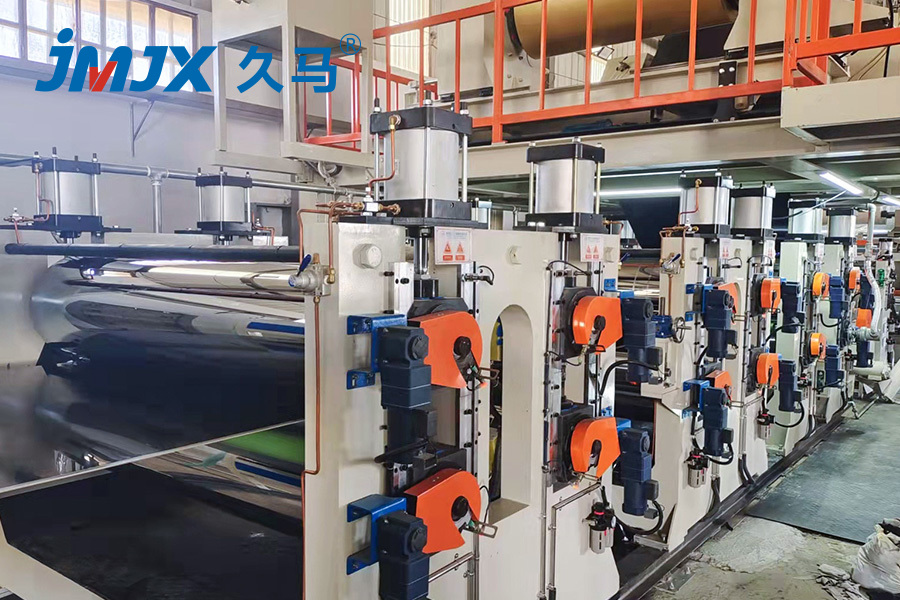
The hot extruded PE core exits the die and is immediately sandwiched between the two pretreated aluminum skins as all three layers pass through a lamination roller stack. The rollers apply controlled pressure and heat to consolidate the bond before the panel cools.
Lamination roller design is critical. Three-roll or five-roll configurations with individually controllable nip pressure across the full width prevent edge-heavy or center-heavy bonding, which causes panel bow or surface waviness. Roller surface temperature is typically held at 60–90°C — above ambient to maintain bond quality, but below the temperature at which the aluminum surface coating would be damaged.
Cooling, Cutting, and Stacking
After lamination, the continuous panel sheet passes through a cooling section — typically a series of water-cooled platens or air-knife cooling — before entering the cutting station. The cooled panel must reach below 40°C before cutting to prevent edge deformation from residual heat.
Flying shear cutters or guillotine cutters trim panels to standard lengths — most commonly 2,440 mm (8 ft) or custom lengths up to 6,000 mm. Finished panels are then stacked automatically with interleaving protective film and bundled for shipping.
Key Equipment Specifications to Evaluate
When comparing PE ACP production lines from different suppliers, these are the specifications that determine production capacity, product range, and long-term operational cost.
| Specification | Entry-Level Line | Mid-Range Line | High-Capacity Line |
|---|---|---|---|
| Max Panel Width | 1,250 mm | 1,575 mm | 2,000 mm+ |
| Production Speed | 3–5 m/min | 6–10 m/min | 12–20 m/min |
| Daily Output (4mm panel) | 800–1,200 m² | 2,000–4,000 m² | 5,000–8,000 m² |
| Extruder Screw Diameter | 90–120 mm | 120–150 mm | 150–200 mm |
| Panel Thickness Range | 3–4 mm | 3–6 mm | 2–8 mm |
| Approximate Line Length | 25–35 m | 40–60 m | 70–100 m |
Production speed is not always the right optimization target. Panel flatness tolerance — typically specified as ≤1.5 mm bow per 1,000 mm panel length for architectural-grade panels — is harder to maintain at higher speeds because the lamination and cooling windows are compressed. High-speed lines require proportionally more sophisticated tension control and cooling capacity to meet flatness specifications.
PE Core Formulation and Its Effect on Panel Properties
The polyethylene core compound is not simply virgin LDPE pellets. The formulation varies significantly depending on the panel's intended application, and the compound directly determines fire performance, stiffness, and cost.
| Core Type | Composition | Fire Rating | Primary Use |
|---|---|---|---|
| Standard PE | ~95% LDPE | B3 / Combustible | Signage, interior, low-rise |
| FR PE (Fire Retardant) | LDPE + ATH/MDH fillers (30–50%) | B2 / Limited combustibility | Commercial facades ≤30m height |
| Mineral-Filled FR | LDPE + 60–70% mineral filler | B1 / Flame retardant | High-rise, public buildings |
| Non-combustible (A2) | Mineral core (no polymer binder) | A2 / Non-combustible | Hospitals, airports, >30m facades |
Note that A2-rated panels use a mineral-filled core that is not processed the same way as PE-based cores. A standard PE ACP production line typically cannot process A2 cores without extruder and die modifications to handle the much higher filler loading and different rheology. If your product roadmap includes A2 panels, specify extruder torque and die pressure ratings accordingly at the time of line purchase — retrofitting is expensive.
ATH (aluminum trihydrate) is the most common FR additive for B2-grade PE cores. It releases water vapor when heated, suppressing flame spread. Loading levels of 40–50% by weight achieve B2 performance but significantly increase melt viscosity, requiring higher extrusion pressures and often a larger-diameter screw.
Critical Quality Control Points Along the Line
Quality control in PE ACP production is most effective when inline sensors detect deviations in real time, before defective product accumulates. The following control points are where experienced operators and automated systems focus their attention:
Core Thickness Uniformity
Core thickness variation across the panel width causes differential thermal expansion during service, leading to panel bow. Beta or X-ray gauging systems mounted after the lamination rollers provide continuous thickness feedback across multiple measurement points. Target tolerance for core thickness in a 4 mm panel is typically ±0.15 mm or better.
Peel Strength Testing
Peel strength is tested destructively on sample cut-offs taken at the start of each production run and periodically throughout. A T-peel or 90° peel test fixture measures the force required to separate the aluminum skin from the PE core. Consistent peel strength below 120 N/25mm indicates a pretreatment or lamination temperature problem and the run should be stopped for investigation.
Surface Flatness and Bow
Finished panels are checked for bow using a straightedge or laser flatness gauge. Sources of bow include uneven roller pressure, asymmetric cooling (one skin cooling faster than the other), or residual stress in the aluminum coil from the rolling process. Matching the tension on both coil feeds and ensuring symmetric cooling across the panel cross-section are the primary corrective actions.
Surface Defect Inspection
Surface defects — scratches, pits, roller marks, or contamination inclusions — are detected by an inline camera inspection system or by trained operators visually inspecting panels under raking light. Roller marks indicate debris on the lamination rollers and require an immediate roller cleaning stop. Surface contamination in the PE melt typically indicates contamination in the feedstock pellets.
Common Production Defects and Their Root Causes
Understanding the relationship between process conditions and defect types enables faster troubleshooting and reduces scrap rates. The following defects account for the majority of production rejections on PE ACP lines:
- Delamination (skin separation): Caused by insufficient primer coat weight, contaminated aluminum surface, lamination roller temperature too low, or line speed exceeding the thermal bonding window
- Panel bow (longitudinal or transverse): Uneven lamination pressure across the width, asymmetric cooling, or mismatched coil tension between the top and bottom aluminum feeds
- Core thickness variation: Extruder output fluctuation, die lip obstruction, or incorrect drawdown ratio setting
- Surface waviness: Excessive lamination roller pressure variation, non-uniform melt temperature across the die width, or roller surface wear
- Gel spots or inclusions in the PE core: Contaminated or degraded PE feedstock, insufficient purging between material changes, or hot spots in the extruder barrel
- Edge delamination only: Insufficient edge trim, inadequate primer at the coil edges, or roller pressure drop at the panel edges due to roller crown mismatch
Edge delamination is particularly common on wider panels above 1,400 mm because maintaining uniform nip pressure across a wide roller requires precise roller grinding and mounting. This is a key quality differentiator between high-precision and budget-tier production lines.
Line Configuration Options and Customization
PE ACP production lines are not standardized off-the-shelf products. Suppliers configure lines to customer specifications, and several optional modules significantly expand the product range the line can produce.
Inline Coating Station
Some lines include an inline PVDF or polyester coating station that applies the decorative or protective surface coating to the outer face of the aluminum skin within the same line pass. This eliminates the need to source pre-painted coil, which can reduce material cost flexibility. However, inline coating adds significant line length (typically 15–20 m additional) and requires curing oven integration.
Protective Film Application
An inline protective PE film laminator applies a peel-off protective film to the panel face immediately after the cutting station. This is standard for architectural-grade panels shipped to fabricators, where surface protection during handling and routing is essential.
Coextrusion for Multi-Layer Cores
Higher-specification lines use a coextrusion die with two extruders feeding different materials into a layered core structure — for example, a standard LDPE center with higher-melt-strength HDPE skin layers on both sides of the core to improve inter-layer adhesion. This configuration increases equipment cost but allows B2 fire performance at lower ATH filler loading, improving processability.
Factors That Affect the Total Cost of Ownership
The purchase price of a PE ACP production line is only the first cost. Operating economics over a 10–15 year machine life depend heavily on energy consumption, consumable costs, scrap rate, and maintenance intervals.
- Energy consumption: A mid-range line typically draws 150–300 kW total installed power. Extruder motor efficiency and zone heater insulation quality significantly affect running energy costs at high production volumes.
- Roller maintenance: Lamination rollers require periodic re-grinding to maintain surface finish and pressure uniformity. Chrome-plated rollers last significantly longer than uncoated steel. Replacement roller sets for a 1,575 mm line cost $15,000–$40,000 depending on specification.
- Scrap rate: Line startup and grade-change scrap is unavoidable, but a well-designed line with rapid-response temperature control and tension management can reduce startup scrap to under 2% of daily output. Poorly designed lines may waste 5–8%.
- Die maintenance: Extrusion dies require periodic cleaning to remove carbonized PE and contamination from the die lips. Internal manifold design affects how frequently cleaning is required — coat-hanger manifold designs self-clean better than T-manifold designs under normal operation.
- Spare parts availability: Proximity to the machine supplier's service network and the availability of consumable spare parts locally are practical considerations that affect unplanned downtime cost more than any single equipment specification.
For a factory producing 3,000 m² per day at full capacity, even a 1% improvement in yield translates to roughly 30 m² of additional sellable product daily — a meaningful economic difference at scale when evaluated against the machine's capital cost.
Selecting the Right PE ACP Production Line for Your Operation
Before approaching suppliers, define these parameters clearly — they determine which machine class is appropriate and prevent over- or under-specification:
- Target product mix: Will you produce standard PE core only, or do you need FR or A2 capability? This drives extruder sizing and die pressure requirements.
- Panel width range: Define the widest panel you intend to produce. Tooling for wider panels is a major cost step — don't over-specify if your market doesn't require it.
- Annual production volume: Calculate required m² per year based on market projections, then work back to required daily output, and then to minimum line speed. Add 20–25% headroom for growth.
- Quality market positioning: Signage and interior panels have looser tolerances than architectural cladding. A line specified for architectural grade will produce signage-grade panels, but not vice versa.
- Power supply and plant footprint: Confirm available electrical supply, floor space, and ceiling height. High-capacity lines can require 70+ meters of floor space and 400–500 kW electrical supply.
Request factory acceptance test (FAT) conditions in the supply contract, specifying minimum peel strength, flatness tolerance, and production speed at rated output. A supplier confident in their line's performance will accept FAT conditions; reluctance to accept measurable acceptance criteria is itself a meaningful signal about machine quality.
News
-
1. Introduction to Laminating Production Line The laminating production line is not simply a machine—it is a strategic s...
READ MORE -
1. Introduction: The Building Block of Modern Architecture Look around any modern cityscape. The shimmering facades of s...
READ MORE -
Introduction to PE Aluminum Composite Panel (ACP) Production 1.1. Brief Overview of PE ACP and Its Applications Polyethy...
READ MORE
 Phone: +86-180 1500 4677
 Tel: +86-519 8899 7278
 Email:
Factory Address 1: No. 19, Guangyi Road, East Development Zone, Guangde City, Anhui Province, China
Factory Address 2: No. 205, Changwu South Road, Wujin District, Changzhou City, Jiangsu Province, China
Copyright © Guangde JiuMa Machinery Co., Ltd.
