
 简体中文
简体中文 English
 عربى
عربى
Laminating Production Line: Technologies, Setup & Performance
Content
- 1 A Laminating Production Line Is the Core Manufacturing System for Any Industry That Bonds Two or More Material Layers Together at Scale
- 2 Core Lamination Technologies Used in Production Lines
- 3 The Major Sections of a Laminating Production Line
- 4 Laminating Production Line Configurations by Industry
- 5 Key Performance Metrics for a Laminating Production Line
- 6 Common Defects in Laminating Production and Their Root Causes
- 7 Automation and Control Systems in Modern Laminating Lines
- 8 Environmental and Regulatory Considerations for Laminating Production Lines
- 9 Planning and Specifying a Laminating Production Line Investment
A Laminating Production Line Is the Core Manufacturing System for Any Industry That Bonds Two or More Material Layers Together at Scale
A laminating production line is an integrated sequence of machinery that continuously bonds two or more substrate layers — paper, film, foil, fabric, foam, board, or combinations thereof — into a unified composite material. Laminating lines are the manufacturing backbone of the flexible packaging, decorative panel, flooring, automotive interior, electronics, and construction materials industries, producing everything from food-safe barrier film to stone-effect PVC furniture wrap, from reflective insulation board to multi-layer medical packaging.
The configuration of a laminating production line — the bonding technology used, the number of lamination stations, the substrate handling system, and the finishing equipment downstream — determines what products can be made, at what quality, and at what output speed. A line optimised for solvent-based adhesive lamination of flexible packaging film operates on fundamentally different principles from a thermal lamination line for decorative paper or a PUR hot-melt line for automotive door trim. Getting the line specification right for the target product and production volume is the most consequential decision in laminating plant investment.
Core Lamination Technologies Used in Production Lines
The bonding method at the heart of any laminating line determines the adhesion strength achievable, the substrates that can be processed, the line speed, and the solvent and energy requirements of the operation. Each technology has a defined set of applications where it performs best.
Solvent-Based Adhesive Lamination
Solvent-based lamination uses a two-component polyurethane adhesive dissolved in organic solvent (typically ethyl acetate or MEK) that is applied to one substrate via a gravure or comma bar coater, dried in a heated tunnel oven to evaporate the solvent, and then nipped against the second substrate under controlled pressure and temperature. Bond strengths of 3–6 N/15mm are routinely achieved, with bond development continuing over a post-lamination curing period of 24–72 hours at 40–50°C. Solvent-based lamination dominates flexible food packaging production where high bond strength, chemical resistance, and barrier integrity are required across multi-layer structures including PET/AL/PE and OPP/CPP combinations. Line speeds of 200–400 metres per minute are standard in high-volume flexible packaging facilities.
Waterborne (Water-Based) Adhesive Lamination
Waterborne lamination replaces organic solvent with water as the adhesive carrier, dramatically reducing VOC (volatile organic compound) emissions and eliminating the solvent recovery or abatement infrastructure required in solvent-based lines. The adhesive — typically an acrylic or PVA-based emulsion — is applied, dried in a longer or hotter oven section, and nipped. Waterborne lines typically run at 80–180 metres per minute — slower than solvent lines due to the higher latent heat of evaporation of water compared to solvents — and achieve somewhat lower bond strengths, making them more suitable for paper-to-paper, paper-to-board, and decorative film applications than for demanding flexible packaging. Regulatory pressure on VOC emissions in the EU and China is driving significant investment in waterborne lamination line technology.
Hot-Melt and PUR Lamination
Hot-melt lamination uses thermoplastic adhesives — EVA (ethylene vinyl acetate), polyolefin, or reactive PUR (polyurethane reactive) — applied in molten form at temperatures of 120–180°C, which cool and solidify on contact with the substrate to form an immediate bond. PUR hot-melt adhesives cure further through moisture crosslinking after application, producing bond strengths and heat resistance significantly higher than conventional EVA hot-melts. PUR lamination lines achieve peel strengths exceeding 8 N/15mm and service temperature resistance up to 100°C or more — performance levels required for automotive interior trim, footwear, and technical textile lamination. Hot-melt lines are solvent-free and produce no VOC emissions, simplifying environmental compliance. Line speeds vary widely: 20–80 metres per minute for PUR slot-die or roll-coat applications, up to 150 metres per minute for EVA curtain coating on paper and board.
Extrusion Lamination and Coating
Extrusion lamination lines melt thermoplastic resin (PE, PP, ionomer, or EVOH) in a screw extruder and extrude a thin molten curtain directly onto a moving substrate, simultaneously bonding a second substrate in a nip roll against the freshly extruded layer. This produces multi-layer composites with an integral plastic layer — the packaging-grade coated papers, foil laminates, and liquid board used in beverage cartons (such as Tetra Pak construction) are manufactured this way. Extrusion lamination lines run at 150–500 metres per minute and apply coatings as thin as 10–15 gsm, making them highly material-efficient at high production volumes. The capital cost is higher than adhesive lamination lines due to the extruder, die, and associated equipment.
Thermal / Heat-Activated Film Lamination
Thermal lamination lines bond pre-coated film (typically BOPP, PET, or nylon with a heat-activated adhesive layer already applied) to paper or board substrates by passing both through heated rollers under pressure — no liquid adhesive is applied on the line. This is the dominant technology for graphic arts and print finishing lamination — the gloss or matt film applied to book covers, packaging cartons, and printed marketing materials. Thermal lamination lines are compact, clean, and fast (80–200 metres per minute for roll-to-roll configurations), and require no solvent handling or extended drying. They are unsuitable for substrates that cannot withstand the lamination temperature (typically 80–130°C).
The Major Sections of a Laminating Production Line
Regardless of the bonding technology used, every continuous laminating production line shares a common sequence of functional sections that take raw substrate rolls in and deliver finished laminated material out. Understanding each section's role clarifies how the overall line design affects output quality and throughput.
Unwind Stations and Substrate Handling
The unwind stations feed raw substrate rolls into the line at controlled tension. Dual-unwind (flying splice) systems allow roll changes without stopping the line — a new roll is pre-staged, and an automatic splicer joins the tail of the exhausted roll to the leader of the new roll at full line speed, eliminating production downtime. Tension control across the unwind is critical: too little tension causes substrate wrinkles and registration errors; too much causes film stretching, particularly problematic with elastic substrates like PE or soft PVC. Dancer rolls, load-cell feedback, and closed-loop tension controllers maintain the web tension within ±1–2% of setpoint across speed variations.
Pre-Treatment Section (Corona, Flame, or Plasma)
Many film substrates — particularly polyolefins such as PE, PP, and OPP — have inherently low surface energy that prevents adhesive wetting and bonding. Pre-treatment raises the substrate's surface energy before adhesive application. Corona treatment is the most widely used method, exposing the film surface to a high-frequency electrical discharge that oxidises the surface and raises surface energy from a typical 30–32 mN/m to 38–44 mN/m — sufficient for reliable adhesive wetting. Flame treatment and atmospheric plasma treatment achieve similar results, with plasma offering greater uniformity for complex surface profiles. Surface energy decays over time after treatment, so pre-treatment is always positioned immediately upstream of the adhesive coating station.
Adhesive Application Station
The adhesive coating station applies a precise, uniform layer of adhesive to one or both substrates at a controlled coat weight (gsm). The coating method varies by adhesive type and viscosity:
- Gravure coating: An engraved cylinder picks up adhesive from a trough and transfers it to the substrate. Coat weights from 1–15 gsm are achievable with high uniformity. Standard for solvent and waterborne adhesives in flexible packaging.
- Comma bar / knife-over-roll coating: A fixed blade meters adhesive to a precise gap above the substrate surface. Suitable for medium-to-high viscosity waterborne and hot-melt adhesives. Coat weights of 5–40 gsm.
- Slot-die (die lip) coating: Adhesive is pumped under pressure through a precision slot die directly onto the substrate — no contact between die and substrate. Produces very uniform coat weight across the web width with minimal waste. Preferred for PUR hot-melt and high-precision applications.
- Curtain coating: A free-falling adhesive curtain deposits onto a moving substrate — the substrate passes beneath without contacting the coating head. Very high speed (up to 800 m/min in paper coating) with excellent uniformity at coat weights of 5–30 gsm.
Drying and Curing Oven
For solvent and waterborne adhesive systems, the coated substrate passes through a heated tunnel oven before lamination to evaporate the carrier (solvent or water) and bring the adhesive to its activation temperature. Oven length, airflow velocity, air temperature profile, and web speed must be precisely balanced to ensure complete carrier evaporation without over-heating the substrate. Under-dried adhesive carries residual solvent into the laminate, affecting bond strength and potentially leaving solvent taint in food-contact applications. Oven sections on high-speed flexible packaging lines may be 15–30 metres long with multiple independently controlled heating zones.
Lamination Nip (Bonding Zone)
The lamination nip — a pair of counter-rotating pressure rolls — is where the two substrate webs are brought together and bonded under controlled nip pressure and temperature. Nip pressure, nip temperature, and web tension are the three primary process variables controlling bond quality at this point. Nip pressures in industrial laminating lines typically range from 2 to 8 bar, applied via pneumatic or hydraulic actuators. The nip roll materials — steel, rubber-covered, or silicone — are selected based on the substrate and adhesive combination to ensure uniform pressure distribution across the full web width.
Cooling Section
Immediately after the lamination nip, the bonded composite must be cooled to below the adhesive's softening point before it contacts anything that could mark or distort the surface. Chill rolls — internally water-cooled steel cylinders — contact the laminate and extract heat rapidly, bringing the composite from lamination temperature (which may be 80–130°C in thermal lamination or 120–160°C in hot-melt lines) to below 30°C within 2–4 seconds of web travel. Insufficient cooling results in roll blocking (layers sticking together in the finished roll) and surface defects.
Rewind and Slitting
The finished laminate is wound onto a rewind mandrel at controlled tension to produce a roll with consistent density and without telescoping or edge damage. Many laminating lines include an integrated slitter-rewinder that cuts the full-width master roll into narrower slit rolls of customer-specified widths in a single pass — eliminating the need for a separate slitting operation and reducing handling. Full-width master rolls on industrial laminating lines may be 1,000–2,000 mm wide, slit into finished widths of 100–600 mm depending on end-use requirements.
Laminating Production Line Configurations by Industry
The configuration of a laminating line — the combination of technologies, number of stations, substrate types handled, and downstream equipment — varies significantly by target industry and product type.
| Industry | Typical Lamination Technology | Key Substrates | Typical Line Speed | Critical Performance Requirement |
|---|---|---|---|---|
| Flexible Food Packaging | Solvent-based, extrusion | PET, OPP, AL foil, CPP, PE | 200–400 m/min | Barrier integrity, bond strength, food safety |
| Decorative Panels / Furniture | Waterborne, hot-melt, flat-bed press | PVC film, decorative paper, MDF, PB | 15–80 m/min | Surface uniformity, gloss/texture consistency |
| Automotive Interior Trim | PUR hot-melt, flame lamination | Leather/PU leather, foam, nonwoven | 10–40 m/min | Heat resistance, peel strength, haptics |
| Flooring (LVT / SPC) | Calender lamination, hot press | PVC base, decorative film, wear layer | 5–20 m/min (panel) | Abrasion resistance, dimensional stability |
| Graphic Arts / Print Finishing | Thermal film lamination | BOPP film, coated paper, board | 80–200 m/min | Optical clarity, surface finish, anti-blocking |
| Medical / Pharmaceutical Packaging | Solvent-based, waterborne | Tyvek, AL foil, PET, medical-grade PE | 50–150 m/min | Sterile barrier, peel-open performance, traceability |
| Construction / Insulation | Hot-melt, flame lamination, extrusion | Foil, reflective film, foam, nonwoven | 20–80 m/min | Thermal performance, moisture resistance, durability |
Key Performance Metrics for a Laminating Production Line
Evaluating the performance of a laminating line — whether in procurement, commissioning, or ongoing production management — requires tracking a specific set of metrics that reflect both output quantity and output quality.
Overall Equipment Effectiveness (OEE)
OEE is the single most important summary metric for any production line. It combines three factors: availability (what proportion of scheduled production time the line is actually running), performance (what proportion of maximum rated speed the line achieves when running), and quality (what proportion of output meets specification). World-class OEE for a continuous laminating line is generally considered to be 75–85%; many lines in practice operate at 55–65% OEE, with the gap largely attributable to unplanned downtime and speed losses during substrate changes and setup. Improving OEE by 10 percentage points on a line running 6,000 hours per year at 150 m/min with 1.5 metre web width represents approximately 1,350 additional tonnes of saleable output per year.
Bond Strength and Peel Force
Bond strength — measured as peel force per unit width (N/15mm or N/25mm) using a tensile testing machine — is the primary quality metric for the laminated composite. Testing is typically conducted at 180° or T-peel geometry per ASTM F88 or EN ISO 11339, with the failure mode (adhesive failure at the bond line vs cohesive failure within a substrate) providing diagnostic information about whether the failure limit is in the adhesive chemistry or the substrate material. In-line bond strength monitoring using peel force sensors at the winding station provides real-time feedback during production; offline testing at defined intervals is the minimum quality control requirement.
Coat Weight Uniformity
Adhesive coat weight (gsm) must be uniform across the web width and stable over time. Non-uniform coat weight causes localised bond strength variation — areas of insufficient adhesive produce weak bonds; areas of excess adhesive can cause bleed-through, surface defects, or adhesive waste. Beta-ray or near-infrared (NIR) coat weight gauges mounted across the web provide non-contact, continuous coat weight mapping that enables closed-loop control of the coating station — the most precise coat weight control available. Across-web coat weight variation of ±5% or better is achievable on well-maintained lines with closed-loop control.
Defect Rate and Scrap Percentage
Common laminating defects — bubbles, wrinkles, delamination zones, streaks, and contamination inclusions — generate scrap that reduces yield and increases material cost per unit of saleable output. Automated optical inspection (AOI) systems with line-scan cameras and image processing software detect defects at full line speed, flagging defective sections for removal at the rewinder without requiring the line to slow or stop. AOI is now standard on high-value laminating lines for flexible packaging, electronics, and medical applications, and increasingly adopted in decorative film and flooring lamination where surface defects directly affect product aesthetics.
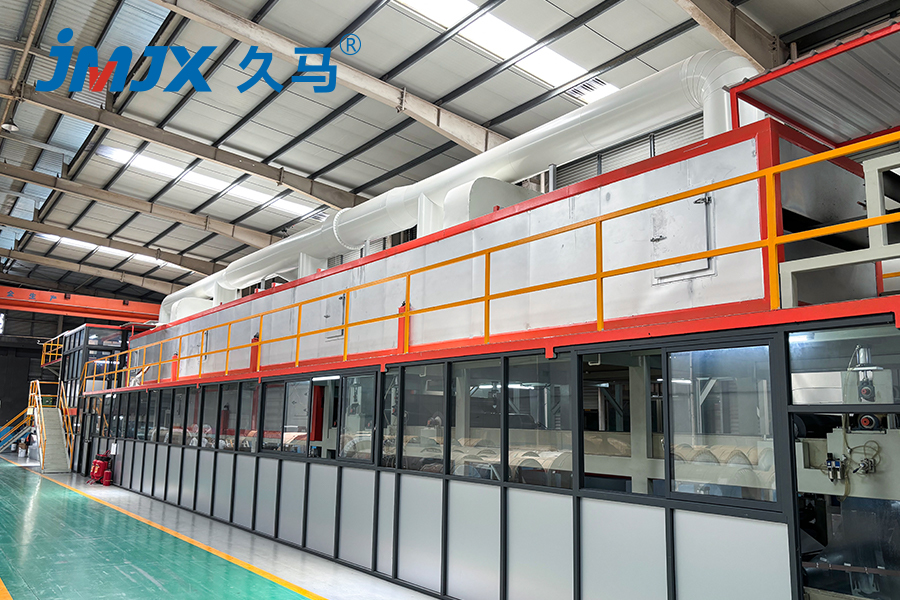
Common Defects in Laminating Production and Their Root Causes
Understanding laminating defects and their causes is essential for process engineers responsible for line qualification, troubleshooting, and continuous improvement. Most defects that appear in the finished laminate originate at a specific point in the process and are traceable to a controllable variable.
- Bubbles and blisters: Caused by trapped air between laminating substrates at the nip, residual solvent or moisture in the adhesive layer, or outgassing from a substrate. Root causes include insufficient nip pressure, under-drying in the oven section, or substrate contamination. Blisters that appear after lamination (delayed blistering) indicate residual solvent that continues to volatilise post-lamination — a more serious defect requiring oven temperature or dwell time adjustment.
- Tunnelling and edge delamination: The laminate delaminates along its edges or develops raised, tunnel-like separations parallel to the machine direction. Caused by tension imbalance between the two substrates entering the nip — if one substrate has more elongation than the other, it will relax after bonding and create compressive stress that opens the bond at the edges. Correct tension matching of both webs is the primary preventive measure.
- Wrinkles: Diagonal or machine-direction wrinkles develop when web tension is too low, when the web is not tracking centrally through the line, or when there is a camber (bow) in the substrate roll. Precision web guiding systems using ultrasonic or optical edge sensors and automated steering rolls correct lateral web position continuously.
- Coat weight variation (streaks): Machine-direction streaks of heavy or light coat weight trace to a damaged gravure cylinder, a blocked slot die, or a contaminated comma bar. Cross-machine direction variation indicates uneven nip pressure or a bowed doctor blade. Regular cylinder inspection and cleaning protocols are the primary preventive measure.
- Blocking in the roll: Laminate layers stick together in the wound roll, making the roll unusable. Caused by insufficient cooling before winding (adhesive still tacky at wind temperature), excessive winding tension, or moisture uptake by the adhesive layer. Chill roll temperature and winding tension are the primary control variables.
- Poor bond development: Laminate passes peel force testing immediately after production but fails after 24–72 hours in storage. This indicates under-mixing or under-dosing of the hardener in two-component adhesive systems — a critical process control failure that requires adhesive mixing system verification and inline viscosity monitoring.
Automation and Control Systems in Modern Laminating Lines
The level of automation in a laminating production line directly determines its consistency, speed of response to process deviations, and the skill level required to operate it. Modern high-performance laminating lines integrate several layers of control technology that would have required dedicated process engineers to manage manually a generation ago.
Programmable Logic Controllers (PLC) and HMI Systems
The base control layer of any industrial laminating line is a PLC system — typically Siemens S7, Allen-Bradley, or Beckhoff — that manages all actuator commands, sensor inputs, safety interlocks, and sequence control in real time. Modern laminating lines store dozens or hundreds of product recipes in the PLC, allowing an operator to switch from one product specification to another by selecting the recipe name on a touchscreen HMI — the line then automatically sets all speed, tension, temperature, nip pressure, and adhesive parameters to their programmed setpoints for that product. This eliminates the manual setup variations that historically caused significant quality losses at product changeover.
Closed-Loop Process Control
Closed-loop control uses real-time sensor feedback to automatically correct process variables when they deviate from setpoint — without operator intervention. Key closed-loop systems on a laminating line include tension control (dancer roll position feeding back to unwind brake or motor torque), coat weight control (NIR gauge output feeding back to coating station metering speed or pump rate), temperature control (thermocouple feedback to oven zone heaters and chill roll chiller), and web guiding (edge or line sensor feedback to steering roll actuator). Closed-loop systems respond to disturbances in milliseconds — far faster than any operator can react — and maintain process variables within tighter tolerances than manual control, directly improving product consistency and reducing waste.
Industry 4.0 Integration and Remote Monitoring
Leading laminating line manufacturers now offer Industry 4.0 connectivity as standard — OPC-UA data interfaces that stream real-time process data to manufacturing execution systems (MES), ERP platforms, and cloud-based analytics dashboards. This enables predictive maintenance based on vibration signatures of rolls and drives, real-time production reporting without manual data entry, and remote expert diagnostics by the machine manufacturer without an engineer travelling to site. For multi-site laminating operations, centralised dashboards allow process and quality data to be compared across lines and plants, identifying best-practice settings from high-performing lines that can be transferred to lower-performing ones.
Environmental and Regulatory Considerations for Laminating Production Lines
Laminating production — particularly solvent-based adhesive lamination — generates VOC emissions and solvent waste streams that are subject to increasingly stringent environmental regulation in most markets. Understanding the regulatory landscape and the engineering options for compliance is an essential part of laminating line investment planning.
VOC Emission Abatement Systems
Solvent-based laminating lines must either recover solvent (for reuse or sale) or destroy it before emission to atmosphere. Thermal oxidisers (TO) and regenerative thermal oxidisers (RTO) are the most widely installed abatement technology — the solvent-laden air stream from the drying oven is combusted at 750–850°C, converting organic compounds to CO₂ and water. RTOs use a ceramic heat exchange bed to recover 90–95% of the combustion heat to pre-heat incoming process air, reducing fuel consumption dramatically compared to simple direct-fired thermal oxidisers. Catalytic oxidisers operate at lower temperatures (300–450°C) using a precious metal catalyst, consuming less energy but requiring periodic catalyst replacement and careful management to avoid catalyst poisoning. For very high solvent concentrations, solvent recovery by condenser or activated carbon adsorption is economically preferred over destruction.
EU Solvent Emissions Directive and Equivalent Regulations
In the EU, laminating operations above defined consumption thresholds are subject to the Industrial Emissions Directive (IED, 2010/75/EU), which sets VOC emission limit values and requires operators to hold an environmental permit. Operations consuming more than 5 tonnes of solvent per year must either comply with emission limit values (typically 20–50 mg C/Nm³ in exhaust) or implement a reduction scheme demonstrating equivalent overall emission reduction. Similar frameworks apply under the US EPA NESHAP regulations for flexible packaging printing and laminating. These regulatory requirements are driving significant capital investment in waterborne and solvent-free lamination technology as operators seek to eliminate solvent abatement costs and compliance risk.
Sustainable Laminating Technologies and Material Choices
Beyond emissions management, the laminating industry faces pressure to develop products that are more recyclable and compatible with circular economy packaging requirements. Multi-layer laminates combining dissimilar materials (e.g. PET/AL foil/PE) are difficult or impossible to recycle through standard material streams. Mono-material laminate structures — all-PE or all-PP film composites that retain barrier performance while being recyclable in polyolefin streams — are an active area of development in flexible packaging lamination. Waterborne adhesives and PUR hot-melt systems that can be delaminated during the recycling process (de-laminatable adhesives) are a complementary development enabling recovery of constituent materials from end-of-life laminates.
Planning and Specifying a Laminating Production Line Investment
Investing in a laminating production line — whether a first line for a new operation or an upgrade to an existing facility — requires structured evaluation of product requirements, production targets, site constraints, and capital budget before engaging equipment suppliers. The decisions made at this stage define the line's capability and economics for the next 15–25 years of its operational life.
- Define the product portfolio and substrate range: Identify all substrate combinations, adhesive types, coat weights, laminate widths, and surface finishes the line must handle — including potential future products. A line designed only for current products may be obsolete within 5 years if market requirements shift.
- Calculate required output and line speed: Work back from annual production volume (tonnes or square metres) and planned operating hours to determine the minimum line speed needed, accounting for realistic OEE (not theoretical maximum speed). Specify line speed at 75–80% OEE rather than theoretical maximum to ensure the line delivers committed volumes under realistic operating conditions.
- Select lamination technology to match product and regulatory requirements: If the product portfolio includes food-contact packaging requiring high bond strength and barrier integrity, solvent-based or extrusion lamination is likely necessary. If VOC regulations or plant location make solvent handling impractical, waterborne or PUR hot-melt alternatives must be evaluated against the performance requirements.
- Assess site infrastructure requirements: Solvent-based lines require explosion-proof electrical classification (ATEX in the EU), solvent storage, abatement systems, and specialist ventilation. Hot-melt and waterborne lines have much simpler site requirements. Infrastructure investment can add 20–40% to the cost of a solvent-based laminating line compared to an equivalent waterborne or hot-melt installation in a new facility.
- Evaluate total cost of ownership, not only capital cost: A lower-cost line with higher energy consumption, more frequent maintenance requirements, and slower changeover times may have a higher total cost of ownership over a 10-year horizon than a more expensive, more automated line. Energy, adhesive waste, labour, and downtime costs should all be modelled for the expected production mix before making a final capital decision.
- Request process trials before purchase: Reputable laminating line manufacturers operate demonstration facilities or can arrange process trials on customer-supplied substrates. Conducting trials on representative product combinations is the only reliable way to verify that a proposed line will meet bond strength, coat weight, and production speed targets before capital is committed. Trial results also form the basis of process parameters and quality specifications for the production line contract.
News
-
1. Introduction to Laminating Production Line The laminating production line is not simply a machine—it is a strategic s...
READ MORE -
1. Introduction: The Building Block of Modern Architecture Look around any modern cityscape. The shimmering facades of s...
READ MORE -
Introduction to PE Aluminum Composite Panel (ACP) Production 1.1. Brief Overview of PE ACP and Its Applications Polyethy...
READ MORE
 Phone: +86-180 1500 4677
 Tel: +86-519 8899 7278
 Email:
Factory Address 1: No. 19, Guangyi Road, East Development Zone, Guangde City, Anhui Province, China
Factory Address 2: No. 205, Changwu South Road, Wujin District, Changzhou City, Jiangsu Province, China
Copyright © Guangde JiuMa Machinery Co., Ltd.
