
 简体中文
简体中文 English
 عربى
عربى
PE ACP Production Line: Process, Equipment & Buying Guide
A PE ACP production line is a continuous manufacturing system that produces polyethylene-core aluminium composite panels — the flat, lightweight cladding material used extensively in building facades, signage, and interior fit-outs. A complete PE ACP line takes aluminium coil, polyethylene core material, and adhesive film as inputs and delivers finished, coated, and cut composite panel as output, typically at speeds of 6 to 12 metres per minute. If you are evaluating a line for investment, setting up a new manufacturing facility, or upgrading an existing one, understanding each process stage, the critical equipment involved, and the specifications that separate productive lines from problematic ones is essential before committing capital.
Content
- 1 What PE ACP Is and Why the Production Line Design Matters
- 2 The Complete Production Process Stage by Stage
- 3 Core Equipment Specifications and What They Mean for Output Quality
- 4 Line Configurations: Inline Coating vs. Pre-Coated Aluminium
- 5 Output Capacity and What Determines Daily Production Volume
- 6 Quality Control Points Along the Line
- 7 Capital Investment, Operating Costs, and Payback Considerations
- 8 What to Evaluate When Comparing PE ACP Line Suppliers
What PE ACP Is and Why the Production Line Design Matters
PE ACP (polyethylene aluminium composite panel) consists of two aluminium skins — typically 0.21mm to 0.50mm thick each — bonded to a low-density polyethylene core that makes up the majority of the panel's total thickness, usually 3mm, 4mm, or 6mm. A coil-coating layer on the outer aluminium surface provides the decorative finish and weather resistance.
The production line must simultaneously control aluminium surface treatment, adhesive bonding, core extrusion or co-extrusion, lamination pressure and temperature, coating uniformity, and precise dimensional cutting — all in a single continuous pass. Any weak link in this chain directly compromises peel strength, flatness tolerance, or coating adhesion, which are the three properties most closely scrutinized in quality audits and building code compliance testing.
PE core is the standard specification for interior applications and general-purpose cladding. It is distinct from FR (fire-retardant) ACP, which uses a mineral-filled core. A PE ACP line can often be adapted to produce FR core panels with modifications to the extrusion unit, but the two product types require different process parameters and raw materials.
The Complete Production Process Stage by Stage
A full PE ACP production line is typically 80 to 150 metres in length and integrates the following sequential process zones.
Aluminium Coil Uncoiling and Levelling
The process begins with decoilers feeding the upper and lower aluminium coils into the line. Double-headed decoilers allow continuous production by pre-loading the next coil while the first is running, minimising downtime at coil changes. A straightening and levelling unit immediately downstream removes coil set and ensures the aluminium strip enters subsequent stages flat to within ±0.5mm per metre — a tolerance that directly determines final panel flatness.
Surface Pre-Treatment
Clean aluminium surface is critical for adhesive bonding. The pre-treatment section performs chemical cleaning, degreasing, and surface activation. Common processes include alkaline cleaning followed by chromate or chrome-free conversion coating. Chrome-free pre-treatment systems based on titanium or zirconium compounds are increasingly standard due to environmental regulations restricting hexavalent chromium in manufacturing processes across the EU and many Asian markets.
Adhesive Film Application
A hot-melt adhesive film — typically a modified polyethylene or ethylene-vinyl acetate (EVA) compound — is applied between the aluminium skins and the PE core. The film is fed from roll and pre-heated before entering the lamination nip. Adhesive film weight typically ranges from 50 to 120 gsm depending on the bonding requirements of the specific panel specification.
Core Extrusion
The PE core is produced inline by one or more single-screw or twin-screw extruders. The extruder melts and homogenises PE resin pellets and delivers a continuous flat sheet of molten core material through a flat die. Die gap, melt temperature, and line speed must be precisely coordinated to produce a core of consistent thickness and density. Core thickness variation should be held within ±0.1mm to ensure consistent panel stiffness and flatness across the production run.
Lamination and Bonding
The sandwich structure — lower aluminium skin, adhesive film, PE core, adhesive film, upper aluminium skin — converges at the lamination press. A heated double-belt press or roller laminator applies controlled pressure and temperature to achieve a permanent bond. Lamination temperature typically ranges from 180°C to 230°C and pressure from 0.3 to 1.0 MPa depending on the adhesive system and line speed. Insufficient pressure produces weak bonding; excessive temperature degrades the PE core and causes surface bubbling.
Cooling Section
After lamination, the composite panel must be cooled uniformly before cutting to prevent residual thermal stresses that cause warping. Water-cooled roller tables or air-cooling tunnels of 10 to 20 metres in length bring the panel temperature down to ambient before it reaches the trimming and cutting station.
Edge Trimming and Panel Cutting
Rotary slitting knives trim both longitudinal edges to the specified panel width. A flying shear or guillotine then cuts the panel to the specified length. Flying shear systems cut without stopping the line, maintaining production speed. Length accuracy is typically ±1mm per 4-metre panel on well-calibrated systems.
Protective Film Application and Stacking
A protective PE film is laminated to the finished panel surface to prevent scratching during handling, transport, and installation. Panels are then stacked on pallets by an automatic stacker or manually, interleaved with foam or paper separators, and prepared for dispatch.
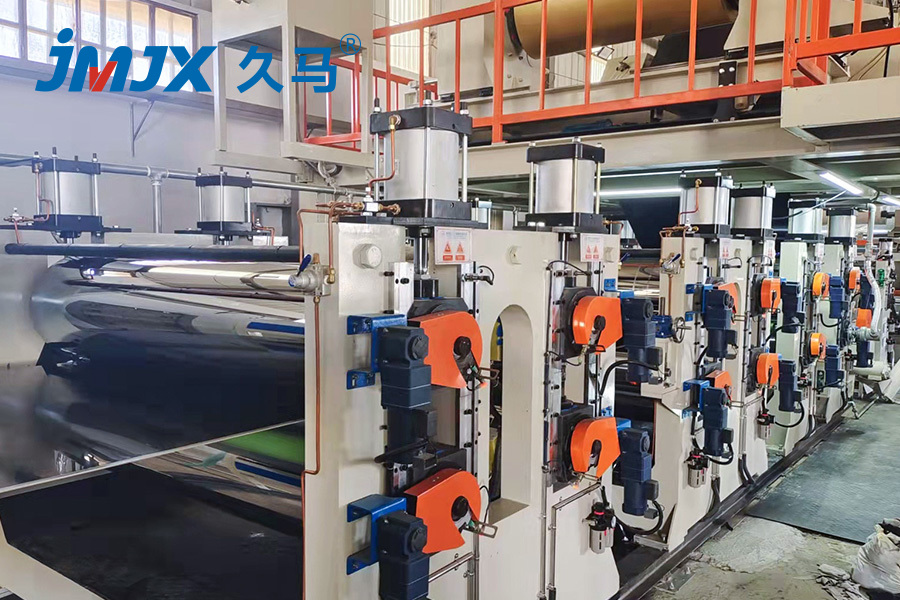
Core Equipment Specifications and What They Mean for Output Quality
The performance of a PE ACP line is determined by the specifications of its major equipment units. These parameters directly affect production speed, product quality consistency, and operational cost.
| Equipment Unit | Key Specification | Typical Range | Impact on Production |
|---|---|---|---|
| Decoiler | Max coil weight | 3,000 – 8,000 kg | Longer coil runs, fewer stoppages |
| Extruder | Screw diameter / L/D ratio | 90–150mm / 28:1–33:1 | Core homogeneity and output rate |
| Lamination press | Belt length / pressure range | 3–8m / 0.3–1.0 MPa | Bond strength and surface flatness |
| Cooling section | Cooling length | 10 – 25 metres | Panel flatness, warp prevention |
| Flying shear | Cutting accuracy | ±1mm per 4m panel | Dimensional consistency, yield |
| Overall line speed | Production speed | 6 – 15 m/min | Daily output volume |
Line Configurations: Inline Coating vs. Pre-Coated Aluminium
One of the most important decisions when configuring a PE ACP production line is whether to use pre-coated aluminium coil or to coat the aluminium inline as part of the ACP process. Each approach has significant cost, quality, and operational implications.
Pre-Coated Aluminium Coil
The majority of PE ACP producers worldwide use aluminium coil that has already been coil-coated with PVDF (polyvinylidene fluoride) or polyester paint by a specialist aluminium processor. This approach simplifies the ACP line itself — no coating equipment is needed — and allows manufacturers to source a wide range of colours and finishes from coil coating specialists. Pre-coated coil accounts for approximately 70–80% of raw material cost in a standard PE ACP operation, making supplier selection and coil specification the primary cost lever.
Inline Coil Coating
Larger, vertically integrated producers incorporate a coil coating line upstream of the ACP lamination section. This involves chemical pre-treatment tanks, roll coaters, and a curing oven capable of reaching peak metal temperatures of 215–260°C for PVDF coatings. Inline coating enables greater control over colour consistency, faster response to custom orders, and significantly reduced raw material cost per square metre — but requires substantially higher capital investment (typically adding $2–5 million USD to line cost) and specialist process expertise.
Output Capacity and What Determines Daily Production Volume
Rated line speed does not translate directly into daily panel output. Several operational factors reduce effective production time and must be accounted for in capacity planning.
- Coil change time: Each coil change on a single decoiler takes 15–30 minutes. Double-headed decoilers reduce this to under 5 minutes, recovering significant production time over a shift.
- Colour and thickness changeovers: Switching between panel specifications requires purging the extruder, adjusting die settings, and running trial panels — typically 20–45 minutes per changeover depending on the magnitude of the change.
- Scheduled maintenance: Blade replacement on slitting knives, belt inspection on the lamination press, and extruder screw checks should be factored into weekly schedules.
- Yield loss: Lead-in and lead-out material at coil starts and ends, edge trim waste, and trial panels during startup typically account for 3–8% of total material input on a well-run line.
A line rated at 10 m/min producing standard 4mm × 1220mm × 2440mm panels, running two 8-hour shifts with realistic utilisation of 75–80%, will typically yield 3,500 to 4,500 panels per day — a figure significantly below theoretical maximum speed calculations.
Quality Control Points Along the Line
Consistent panel quality requires systematic process monitoring rather than end-of-line inspection alone. Critical control points are distributed throughout the production sequence.
- Incoming aluminium coil: Verify thickness, tensile strength, temper, and coating adhesion against supplier certificates before loading. Sub-specification coil causes downstream problems that are difficult to detect until panels are already cut.
- Pre-treatment bath chemistry: Monitor pH, concentration, and temperature of cleaning and conversion coating baths at least once per shift. Depleted or contaminated baths directly cause adhesion failures that only become apparent in peel strength testing.
- Core thickness: Use online laser or contact gauging immediately after the extrusion die to detect and correct core thickness drift before it propagates through the lamination section.
- Lamination temperature and pressure: Log all process parameters automatically and cross-reference with peel strength test results from production samples to build process capability data over time.
- Finished panel testing: Sample panels should be tested for peel strength (minimum 40 N/10mm per common ACP standards), flatness deviation, diagonal measurement (squareness), and coating adhesion via cross-hatch test per ISO 2409.
Capital Investment, Operating Costs, and Payback Considerations
Investment in a PE ACP production line ranges considerably based on line speed, automation level, width capacity, and whether inline coating is included. Understanding the cost structure helps model realistic payback scenarios.
Equipment Cost Range
A complete PE ACP lamination line without inline coating — from decoilers through to stacker — from established Chinese equipment manufacturers typically costs $800,000 to $2.5 million USD depending on specification. European or Taiwanese-manufactured lines command a premium of 30–80% over comparable Chinese equipment but offer tighter tolerances, longer component life, and more comprehensive after-sales support. Lines including inline coil coating add $2–5 million to the above figures.
Key Operating Cost Drivers
- Aluminium coil: The dominant raw material cost, typically representing 55–65% of total production cost. Aluminium price volatility directly impacts margin unless hedged or passed through to customers.
- PE resin: Core material cost, linked to polyethylene commodity pricing. Usually 10–15% of production cost for standard 4mm panels.
- Energy: Extruder heating, lamination press, and pre-treatment baths are the main energy consumers. A mid-sized line typically consumes 300–600 kWh per hour at full production.
- Labour: A standard line requires 4–8 operators per shift depending on automation level. Automated stacking and coil handling reduce headcount requirements significantly.
Payback Period
In markets with healthy ACP demand and stable raw material supply, well-operated PE ACP lines in emerging markets have demonstrated payback periods of 2 to 4 years at two-shift operation. In more competitive or saturated markets, payback extends to 4–7 years. The single most significant variable is not production cost but sales price realisation — lines selling into commodity markets at low margins take substantially longer to pay back than those supplying branded or certified product to construction or export markets at premium pricing.
What to Evaluate When Comparing PE ACP Line Suppliers
Equipment supplier selection is one of the highest-impact decisions in a PE ACP investment. The following checklist covers the areas most commonly underweighted by first-time buyers.
- Reference site visits: Request contact details for at least three operating customers using the same line model and visit at least one in person. Running production tells you far more than any factory demonstration.
- Spare parts availability and lead time: Confirm that critical wear parts — extruder screws, lamination belts, slitting blades, and pre-treatment bath pumps — are stocked locally or can be delivered within 72 hours. Long spare parts lead times are the primary cause of extended unplanned downtime.
- Commissioning support terms: Clarify exactly how many days of on-site commissioning engineers are included, what constitutes line acceptance, and what the response time is for post-commissioning technical issues.
- Process parameter documentation: A quality supplier delivers comprehensive process documentation — recommended settings, troubleshooting guides, and preventive maintenance schedules — not just mechanical drawings. Absence of this documentation is a significant warning sign.
- Compliance and certification capability: If you intend to sell into regulated markets (EU, GCC, North America), confirm the line can produce panels meeting relevant standards such as EN 13501 for fire classification or ASTM E84 for US building code compliance, and that the supplier can assist with product certification testing.
- Upgrade compatibility: Ask whether the line can be upgraded to FR core production, wider panel formats, or higher speeds at a later stage without major structural modification. This preserves flexibility as your product range or market requirements evolve.
News
-
1. Introduction to Laminating Production Line The laminating production line is not simply a machine—it is a strategic s...
READ MORE -
1. Introduction: The Building Block of Modern Architecture Look around any modern cityscape. The shimmering facades of s...
READ MORE -
Introduction to PE Aluminum Composite Panel (ACP) Production 1.1. Brief Overview of PE ACP and Its Applications Polyethy...
READ MORE
 Phone: +86-180 1500 4677
 Tel: +86-519 8899 7278
 Email:
Factory Address 1: No. 19, Guangyi Road, East Development Zone, Guangde City, Anhui Province, China
Factory Address 2: No. 205, Changwu South Road, Wujin District, Changzhou City, Jiangsu Province, China
Copyright © Guangde JiuMa Machinery Co., Ltd.
