
 简体中文
简体中文 English
 عربى
عربى
Multi-Functional Composite Panel Production Line: Guide & Specs
Content
- 1 What Is a Multi-Functional Composite Panel Production Line?
- 2 Panel Types Produced and Their Market Applications
- 3 Core Equipment and Line Architecture
- 4 Key Technical Specifications Across Line Configurations
- 5 Automation, Control Systems, and Industry 4.0 Integration
- 6 Evaluating Suppliers and Total Cost of Ownership
What Is a Multi-Functional Composite Panel Production Line?
A multi-functional composite panel production line is an integrated manufacturing system engineered to produce a range of composite panel products — including wood-plastic composite (WPC), PVC foam board, fiber cement board, aluminum composite panel (ACP), and sandwich structural panels — within a single configurable line or a modular line architecture that can be rapidly reconfigured between product types. The defining characteristic of a multi-functional line, as distinct from a dedicated single-product extrusion or lamination system, is its ability to serve multiple panel specifications and material combinations without requiring a complete equipment rebuild between production runs.
Demand for multi-functional composite panel lines is driven by manufacturers facing diversifying customer requirements in the construction, furniture, transportation, and packaging sectors. A single production facility equipped with a capable multi-functional line can serve the building façade cladding market with ACP in one shift and produce interior furniture substrate panels in another — a flexibility that single-product lines cannot match and that materially improves asset utilization and return on capital investment.
Modern multi-functional composite panel lines integrate extrusion or continuous pressing, surface finishing, cutting, and handling into a single automated production flow, with digital control systems that store and recall product-specific process parameters — enabling operators to transition between panel types in hours rather than days.
Panel Types Produced and Their Market Applications
The commercial value of a multi-functional composite panel production line is determined largely by the breadth and marketability of the panel types it can produce. The following categories represent the most commercially significant products manufactured on modern multi-functional lines.
Wood-Plastic Composite (WPC) Panels
WPC panels combine wood fiber or flour (typically 50–70% by weight) with thermoplastic polymers — predominantly HDPE, PP, or PVC — to produce panels that combine the workability and natural appearance of wood with the moisture resistance and dimensional stability of plastics. End markets include exterior decking, wall cladding, interior flooring, and furniture components. WPC panels are produced by twin-screw extrusion followed by calibration, cooling, and surface embossing to create realistic wood-grain textures. The growing demand for low-maintenance exterior cladding materials, particularly in Europe and North America, has made WPC panel production one of the most commercially attractive capabilities on a multi-functional line.
PVC Foam Board
PVC foam board — also known as Celuka board, forex board, or expanded PVC — is produced by foaming PVC compound through a free-foaming or Celuka extrusion process to create a lightweight, rigid panel with a smooth, machinable surface. Densities range from 0.35 to 0.75 g/cm³ depending on the target application: low-density boards serve signage, exhibition, and display markets; higher-density variants are used as furniture substrate, bathroom cabinetry, and marine interior panels. PVC foam board is one of the highest-margin products achievable on a composite panel line, driven by its wide application range, machinability advantage over wood panels in humid environments, and consistent demand from the advertising and signage industry.
Aluminum Composite Panel (ACP)
ACP consists of two thin aluminum skins (typically 0.3–0.5mm) bonded to a polyethylene or mineral-filled fire-resistant core, forming a lightweight, flat, and stiff panel used extensively in building façade cladding, signage, and interior partitioning. ACP production requires a continuous roll-forming and lamination line that feeds coil aluminum, applies adhesive, laminates the core material, and bonds the second aluminum skin under controlled temperature and pressure — a process distinct from extrusion-based panel production. Multi-functional lines that incorporate ACP capability typically do so through a modular lamination unit that can be engaged or bypassed depending on the production program.
Fiber Cement and Magnesium Oxide (MgO) Board
Inorganic composite boards — fiber cement, MgO board, and calcium silicate board — are increasingly produced on multi-functional lines that integrate wet-process or semi-dry-process forming, continuous pressing, and curing stages. These panels offer fire resistance (A2 or Class 1 fire rating), moisture resistance, and dimensional stability that organic polymer panels cannot match, making them the specification choice for fire-rated partition systems, exterior sheathing, and wet-area wall panels in commercial construction.
Sandwich Structural Panels
Structural sandwich panels — with rigid foam (PIR, EPS, or mineral wool) cores bonded between metal, GRP, or composite facing skins — are produced on continuous double-belt press lines for construction, cold storage, and transportation applications. The insulation performance and structural efficiency of sandwich panels makes them dominant in prefabricated building systems, refrigerated truck bodies, and modular clean-room construction.
Core Equipment and Line Architecture
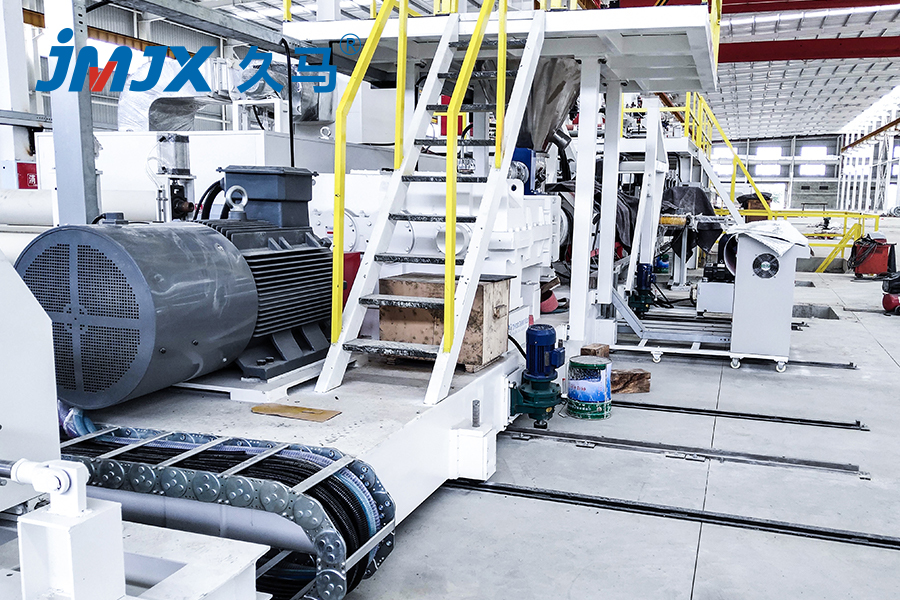
A multi-functional composite panel production line is an assembly of interlinked process stations, each performing a specific transformation of the material stream. The modular architecture of leading systems allows individual stations to be added, removed, or reconfigured as the product mix evolves.
Raw Material Dosing and Mixing
Gravimetric dosing systems precisely meter multiple raw material streams — polymers, fillers, additives, colorants, and blowing agents — into the mixing or compounding stage. Accuracy at this stage directly determines consistency of panel density, color, and physical properties across the production run. High-performance dosing systems achieve feed accuracy of ±0.1% by weight, significantly reducing material waste and batch-to-batch variation compared to volumetric dosing alternatives.
Extrusion or Forming Unit
For polymer-based composite panels, the extrusion unit — typically a co-rotating twin-screw extruder for compounding-intensive products like WPC, or a counter-rotating twin-screw for PVC foam board — is the thermal and mechanical heart of the production line. Screw diameter and L/D ratio (length-to-diameter, typically 32:1 to 48:1 for composite panel applications) determine throughput capacity and the degree of material homogenization achievable. Multi-functional lines often employ modular screw geometries that can be reconfigured for different material systems without replacing the entire extruder barrel.
Die and Calibration System
The flat die (sheet die) forms the extruded melt into the required panel width and nominal thickness profile. Downstream of the die, the calibration unit — a series of precisely machined vacuum sizing plates or rolls through which the still-soft panel passes — sets the final panel dimensions and surface quality. Die design is product-specific: multi-functional lines maintain a library of dies and calibration tooling for each panel type, with changeover times of 2–6 hours depending on die complexity and thermal cycling requirements.
Cooling and Haul-Off
The calibrated panel passes through a water-cooled or air-cooled cooling tank to solidify the panel to handling temperature before the haul-off unit. The haul-off — a synchronized belt or caterpillar puller — applies controlled tension to draw the panel through the calibration and cooling sections at a consistent line speed. Speed synchronization between the extruder output, haul-off, and downstream cutting station is critical for maintaining dimensional consistency along the panel length.
Surface Treatment and Lamination
Inline surface treatment capabilities significantly expand the value of a multi-functional line. Options include corona treatment (improving adhesion for downstream lamination), inline embossing (applying wood grain, stone, or geometric textures directly on the hot panel surface), and decorative film lamination (bonding PVC or paper decorative films to the panel surface in a single inline pass). Inline lamination eliminates a separate offline lamination step, reducing handling, storage space, and labor costs.
Cutting, Stacking, and Handling
Flying cut-off saws or traveling cross-cut saws cut the continuous panel to the required panel length without stopping the production line. Automated stacking systems accumulate cut panels into bundles for packaging and storage, with vision systems performing inline dimensional and surface quality inspection before stacking.
Key Technical Specifications Across Line Configurations
| Parameter | Entry-Level Line | Mid-Scale Line | High-Capacity Line |
|---|---|---|---|
| Panel Width Range | 600–1,220mm | 1,220–1,830mm | Up to 2,440mm |
| Panel Thickness Range | 3–12mm | 3–25mm | 3–40mm |
| Output Capacity | 200–400 kg/hr | 400–800 kg/hr | 800–2,000+ kg/hr |
| Product Changeover Time | 4–8 hours | 2–6 hours | 1–4 hours |
| Extruder Drive Power | 37–75 kW | 75–200 kW | 200–500+ kW |
| Automation Level | Semi-automatic | Mostly automated | Fully automated + MES |
Automation, Control Systems, and Industry 4.0 Integration
The automation architecture of a multi-functional composite panel line has become a primary competitive differentiator, determining not only labor efficiency but also product consistency, energy consumption, and the speed at which the line can respond to quality deviations during production.
Modern lines are controlled by PLC-based systems (Siemens S7 or Allen-Bradley ControlLogix are the dominant platforms in the industry) interfaced with HMI touchscreens that display real-time process data — melt temperature profiles, screw speed, haul-off speed, die pressure, and panel thickness measurements — in a unified operator view. Recipe management systems store complete process parameter sets for each panel product, enabling operators to initiate a product changeover by selecting the new product recipe rather than manually adjusting dozens of individual parameters — dramatically reducing setup time and the risk of process errors during transitions.
Inline quality measurement systems — laser thickness gauges, scanning weight-per-unit-area sensors, and vision inspection cameras — provide continuous feedback to the control system, enabling closed-loop control of panel thickness and surface quality without operator intervention. Statistical process control (SPC) modules log measurement data against specification limits and generate alerts when process capability indices (Cpk) fall below acceptable thresholds, enabling proactive quality management rather than reactive defect detection.
Leading manufacturers are integrating Manufacturing Execution System (MES) connectivity into their lines, enabling production order management, material traceability, OEE (Overall Equipment Effectiveness) tracking, and energy monitoring to be managed from enterprise-level systems rather than line-level controllers. This integration supports the data infrastructure required for certifications such as ISO 9001 and IATF 16949 in automotive-supply composite panel applications.
Evaluating Suppliers and Total Cost of Ownership
A multi-functional composite panel production line represents a capital investment typically ranging from $500,000 for entry-level configurations to $5 million and above for fully automated high-capacity systems. Given this investment scale, supplier evaluation must extend well beyond quoted machine price to encompass the total cost of ownership across a 10–15 year operational life.
Process Engineering Support
The ability of the equipment supplier to provide application-specific process development support — formulation optimization, die design for new panel profiles, and commissioning assistance — is often more valuable than marginal differences in machine specification between competing suppliers. Buyers should request references from existing customers producing similar panel types and visit operational installations before committing to a supplier.
Spare Parts Availability and Lead Times
Production line downtime due to waiting for spare parts can cost tens of thousands of dollars per day in lost output. Evaluate suppliers on their regional spare parts inventory, standard component lead times, and the proportion of critical components sourced from globally available standard brands versus proprietary single-source parts that create supply chain vulnerability. Lines built around standard Siemens, SEW, or Festo components are significantly easier to maintain in regions where the original equipment manufacturer's service network is limited.
Energy Efficiency
Energy consumption — primarily in the extruder drive motors, barrel heaters, and cooling systems — represents a major ongoing operational cost. Specific energy consumption (SEC) expressed as kWh per kilogram of panel output varies significantly between equipment generations: modern variable-frequency drive (VFD) systems on all major motors, energy-recovery cooling systems, and optimized barrel insulation can reduce SEC by 20–35% compared to older equipment designs, representing substantial savings over a multi-decade line life.
Upgrade and Expansion Pathways
The modular architecture of leading multi-functional lines enables incremental capability expansion — adding an inline lamination unit, upgrading to a larger extruder, or installing additional quality measurement systems — without replacing the entire line. Buyers should confirm the upgrade pathway and associated costs with the supplier before purchase, ensuring that the initial capital investment supports the production flexibility the business will require over a five-to-ten-year horizon.
News
-
1. Introduction to Laminating Production Line The laminating production line is not simply a machine—it is a strategic s...
READ MORE -
1. Introduction: The Building Block of Modern Architecture Look around any modern cityscape. The shimmering facades of s...
READ MORE -
Introduction to PE Aluminum Composite Panel (ACP) Production 1.1. Brief Overview of PE ACP and Its Applications Polyethy...
READ MORE
 Phone: +86-180 1500 4677
 Tel: +86-519 8899 7278
 Email:
Factory Address 1: No. 19, Guangyi Road, East Development Zone, Guangde City, Anhui Province, China
Factory Address 2: No. 205, Changwu South Road, Wujin District, Changzhou City, Jiangsu Province, China
Copyright © Guangde JiuMa Machinery Co., Ltd.
